
Our Cities
Braham
Cambridge
Isanti

Braham
Situated in the very northeastern part of Isanti County, Braham was officially incorporated as a village in 1901.Before that, Braham was located 1/4 mile west of its current location, and like Isanti, it moved to its current location to capitalize on the new railroad. There are a few suggestions as to the origin of the name Braham. It has been said that Abraham was chosen by residents, but was denied as another town in Minnesota had submitted the same name. Another theory states that the name Braham has Swedish roots. “Bra” in Swedish means “good” and “hem” means “home” – Good Home. Whatever the origins might be, the majority of Braham’s history has centered on its growth around the railroad.
As it witnessed an influx of population, the town’s industry grew to accommodate its patrons. Having the notoriety of the first hospital in the county, many people in need of care would flock to Braham. The Braham Community Hospital had its start in 1908 and closed in 1974.
Along with serving its residents’ health needs, another first in the county was bringing electricity to rural areas through the REA. Initiated by local businessman and later mayor, Beauford Johnson, and others, the Pine, Isanti, Chisago, & Kanabec (PICK) was established in 1935 and led the charge to bring power to rural landowners. Today, Braham remains loyal to its small-town roots in the sense that it has not seen widespread urbanized development.
Cambridge
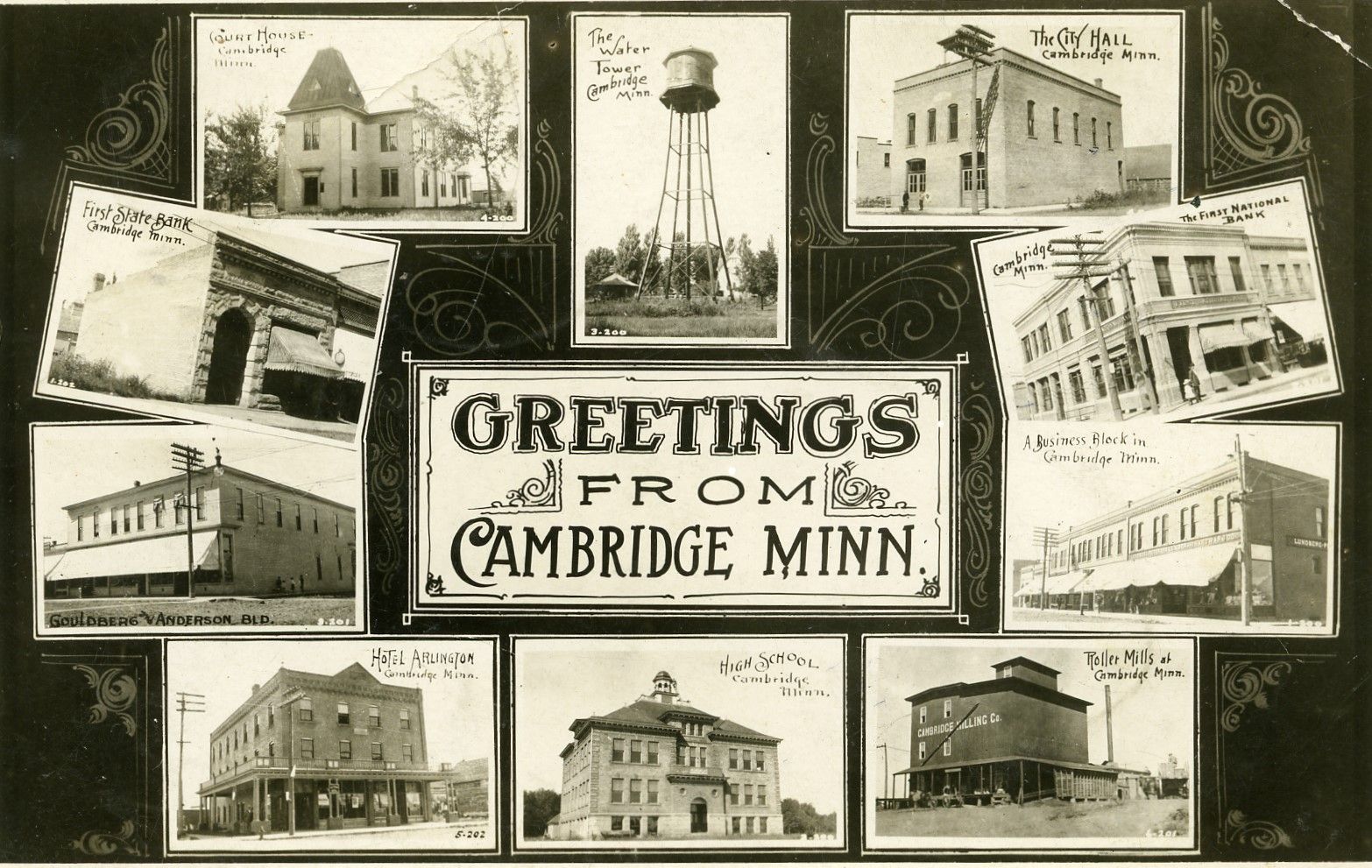
The early history of Cambridge dates to 1856, when speculators arrived in the area in search of land and other resources under the Pre-emption Act. Finding abundant timber, arable land, and the Rum River, the area slowly began to open up for settlement. Much like old Isanti, Cambridge was originally platted in a different location in its early years. Perhaps one of the more notable points in early Cambridge history occurred in 1857, when a family from Connecticut by the name of Griswold secured land around the area of Florence (Paul’s) Lake and began to plat and sell lots to interested parties. The Griswolds lived in a tiny cabin near the lake where they carved out their existence on the Isanti County frontier. Operating a boarding house and a post office, Harriet Griswold became one of the area’s first contacts for early settlement in the wake of her husband Allen’s death. Due to the economic panic of 1857, many of the lot sales stalled out, and eventually, the Griswolds returned to the East Coast.
Mirroring Isanti’s development in the early 1860s, Cambridge also capitalized on settlement activities. Names like Bunker, Conger, Edblad, and Becklin became synonymous with early Cambridge. Another prominent business known simply as the Odell-Conger Stopping Place established a base of operation out of an early trading post and hotel that satisfied the needs of both early residents and travelers. As the American Civil War drew to a close and the Homestead Act became the preferred avenue through which land could be settled, Cambridge began to see further growth and established itself as a village in 1866. During a heated election in 1869, Isanti and Cambridge were locked in battle over the designation of the county seat. George Nesbitt and Ira Conger rallied the county’s population (approximately 2000) to garner votes for their respective towns. In the fall of 1869, Cambridge would officially become the county seat.
As the population continued to increase around the Cambridge area, more businesses and industries capitalized on the Rum River. Several enterprising business owners set up along the banks of the river with a saw mill, flour mill, woolen mill, and later a brick factory. When the railroad came through, Cambridge had many businesses conveniently lined up near the tracks that further solidified the development of the town.
Isanti
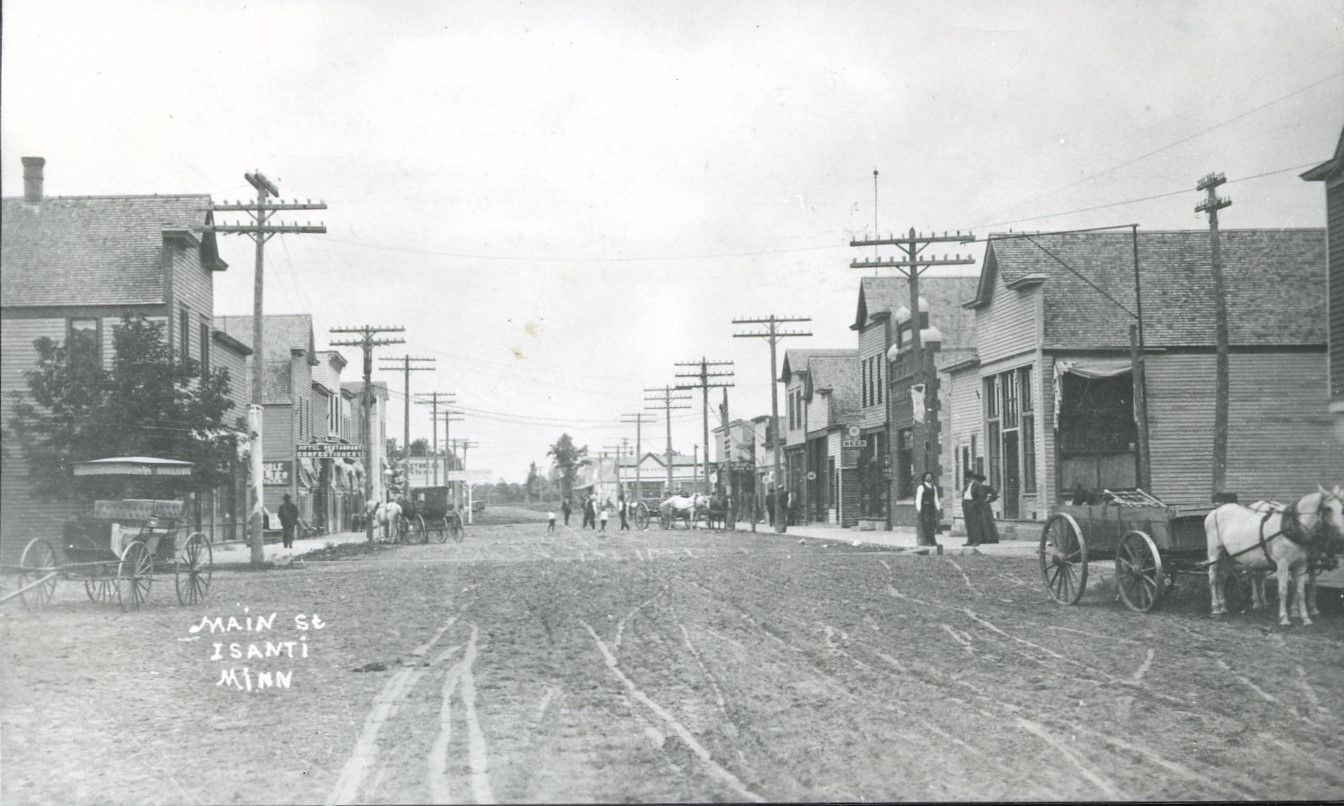
What started as an early settlement on the current intersection of Highway 65 and 301st in Isanti Township, “old” Isanti, can trace its roots back to the early 1860s. Situated on the crossroads of the Princeton-Sunrise and Anoka-Brunswick (Manomin trail), Isanti witnessed many of the earliest settlement activities as loggers, land speculators, settlers, and others stopped as they spread out through the territory. Surnames like Norelius, Eastlund, Chilstrom, Selin, Shulean, Danielson, and others became synonymous with the Isanti area. A gentleman by the name of George Nesbitt opened a hotel and store in 1863, which helped initiate other services like a post office, blacksmith shop, and a school. Along with those amenities, the first church was organized just north of Isanti by members of the Eastlund family in 1860. Eventually, in 1870, a small log structure was built to serve as the county’s first Baptist church.
As the area continued to grow, a ferry located on the Rum River, just west of Isanti, was put into service in 1874. In 1887, a wagon bridge spanned the banks to offer a more stable and reliable method of crossing. By 1899, a significant change occurred near the well-established settlement town. News of the railroad brought much excitement to the area, but when the “Coon Creek Cutoff” of the Great Northern line was laid out, it was to miss Isanti altogether.
So, Isanti pulled up stakes and moved one and a half miles southwest to its current location. Life along the new railroad further spurred the business and economic growth of the town, which laid the path for the town’s eventual residential boom that is steadily increasing to this day.